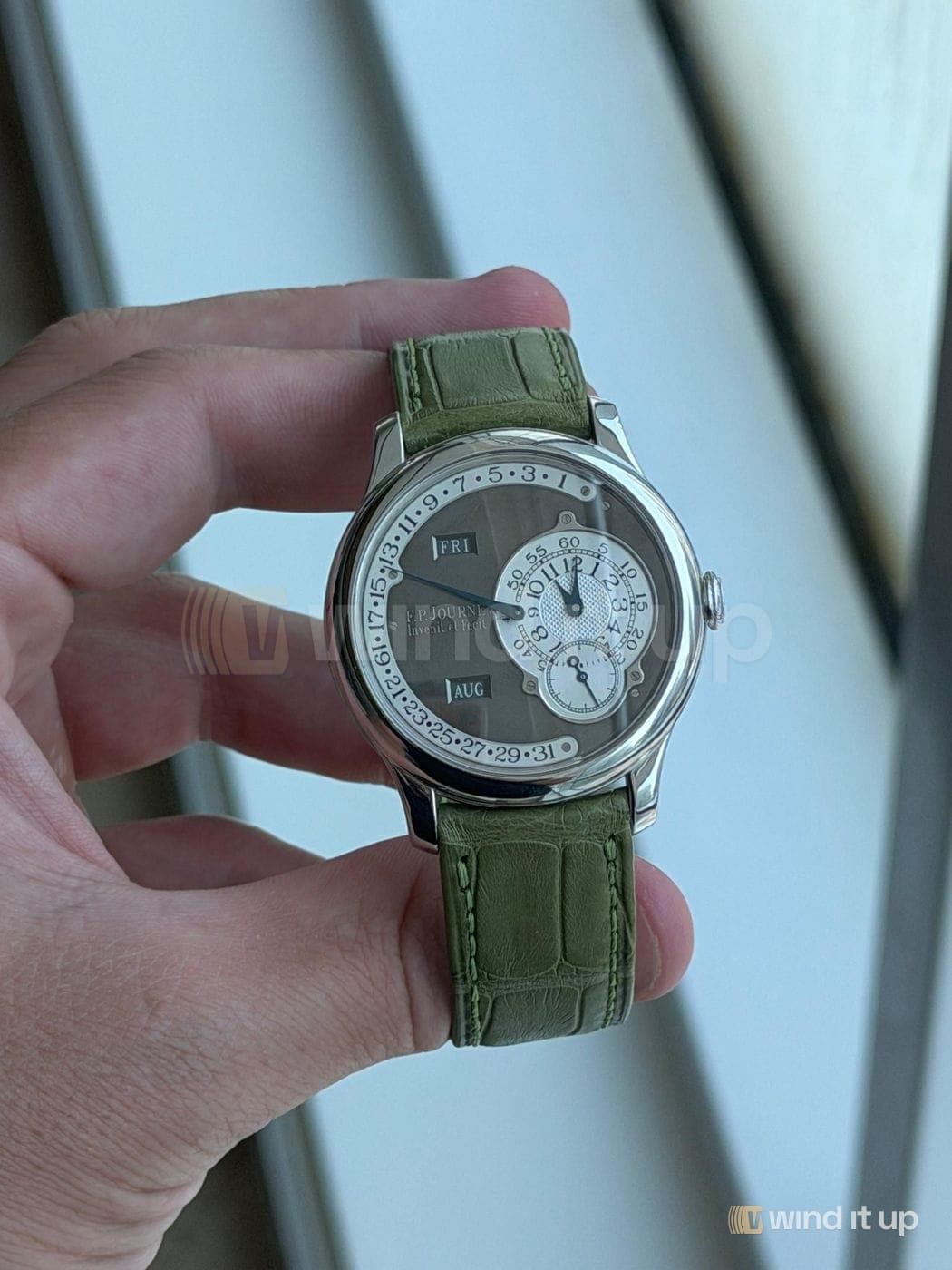
Short on time? The Octa Calendrier Ruthenium is one of five models in F.P. Journe's early-2000s Ruthenium Collection, each made in 99 pieces. Platinum case, dark ruthenium dial, and one of the last Journe movements made in brass rather than gold. It's an annual calendar with roughly five days of power reserve, and it's about as "first-edition Journe" as it gets.
Backstory
Every serious Journe collector has a story about the one that got away, and an annoying number of those stories involve the Ruthenium Collection.
Here's the short version. In the early 2000s, François-Paul Journe put five of his models into a matching set: the Tourbillon Souverain, the Chronomètre à Résonance, the Octa Chronographe, the Octa Réserve de Marche and the Octa Calendrier. Each one got a platinum case, a dial coated in ruthenium (a hard, dark grey metal from the platinum family) and a production run of exactly 99. The series wrapped up in 2004.
What makes it more than a colourway exercise is what's underneath. Journe's early calibres were made in brass, and for this collection the plates and bridges were coated in ruthenium too, so the movement matches the dial. Around 2004 Journe moved to solid 18k gold movements, which became a signature of the brand. So these are some of the last brass Journes, finished in a way no other Journe is. Collectors care about that a lot. So do we.
Key Details
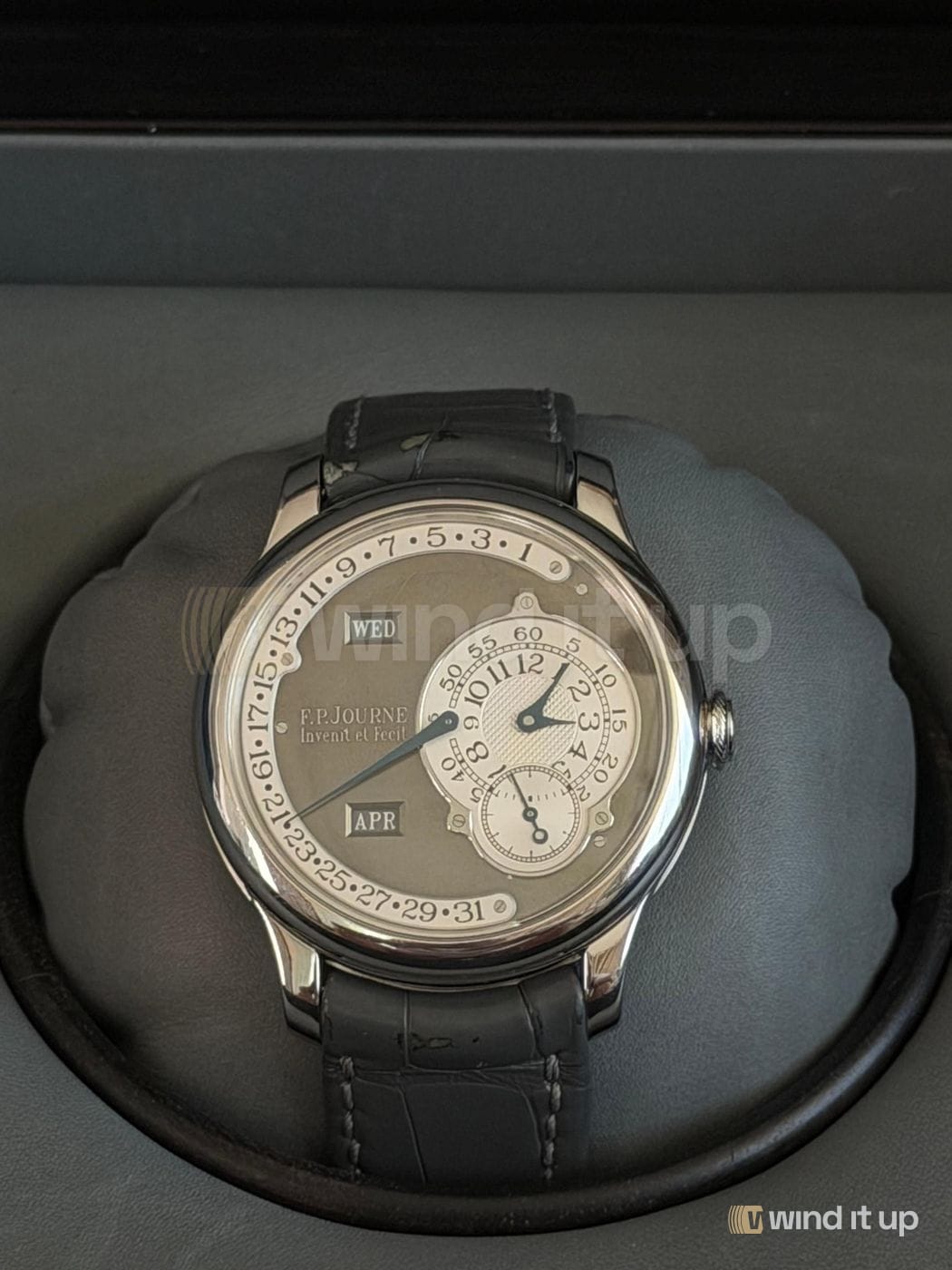
The case is 40mm platinum, which was actually big for Journe at the time. Most of his watches were 38mm back then, and the Ruthenium pieces were among the first to go up a size. It doesn't feel big, though. Platinum gives it that dense, quietly heavy feel, and the shape is classic Journe: clean, round, a little bit formal.
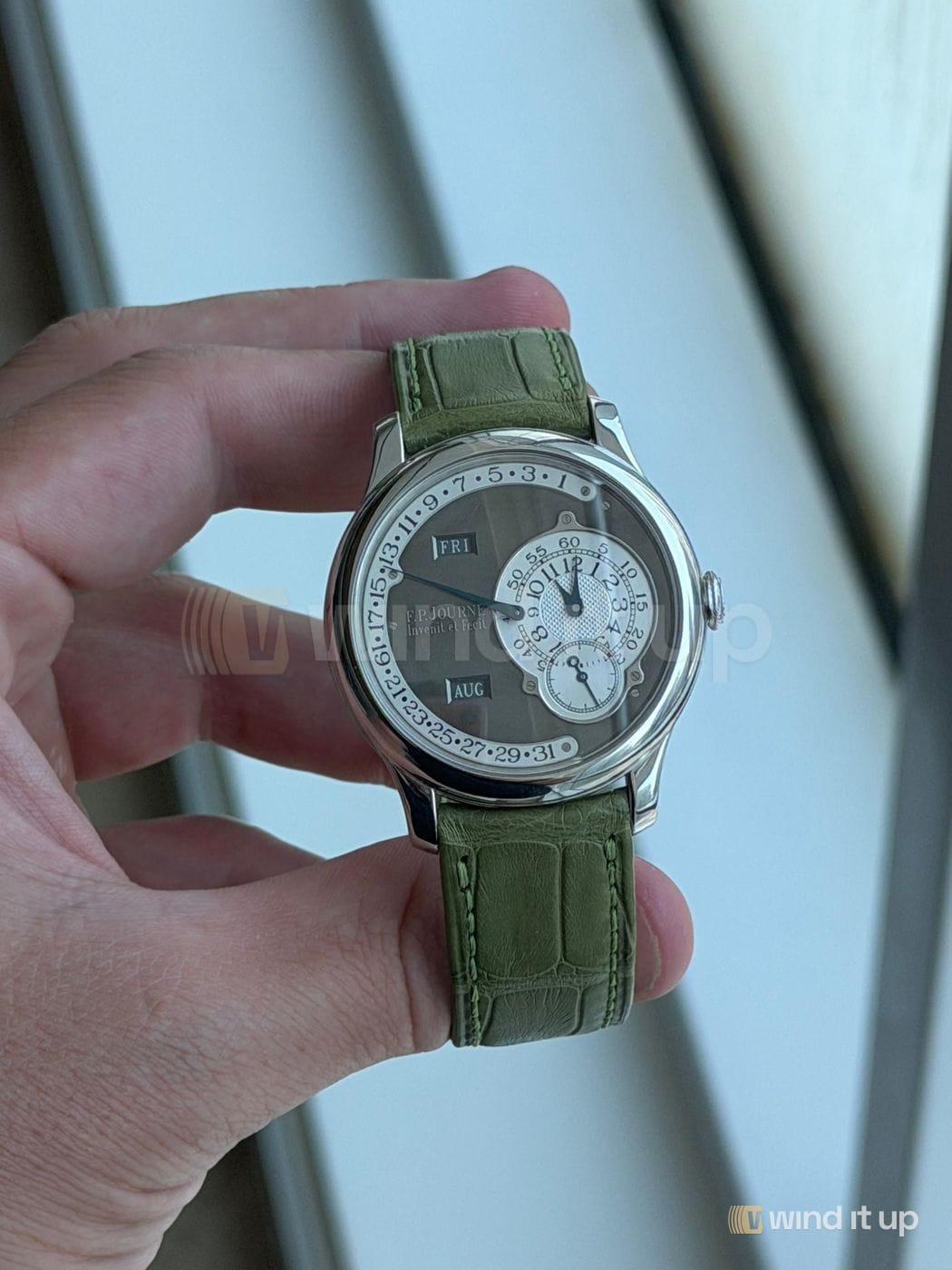
The dial is where the Calendrier earns its name. You get off-centre hours and minutes, a small seconds, a large date, and the day and month, all laid out with that slightly asymmetrical balance Journe is so good at. Against the ruthenium, the printing and hands pop without anything feeling busy.
The Movement
Inside is the automatic calibre 1300, the foundation of the whole Octa family. Journe built it around a big mainspring, and auction catalogues for this piece put the power reserve at five days, roughly 120 hours. In the early 2000s that was a huge number for an automatic. It's still a good one now.
The complication is an annual calendar. It understands 30- and 31-day months on its own, so you only need to step in once a year, at the end of February. For a watch you actually wear, that's the sweet spot: far less fuss than a simple date, and far less fragile and expensive than a perpetual.
On the Wrist
A 40mm platinum watch on a strap is a lovely thing. There's weight, but it's balanced, and the dark dial keeps it from feeling showy. Ours comes on a fresh green strap with the worn grey one included, and honestly the green does something nice with the grey dial. It makes the whole watch look a little less serious.
The one caveat is the brass movement itself. It's not a weakness in any practical sense, but it does mean service history matters, and you want an example that's been looked after properly. Ours has service papers from 2021 and 2025, which is exactly what you'd hope to see.
Final Thoughts
There are more complicated Journes and there are rarer Journes, but very few capture the brand at such an interesting moment. The Ruthenium Octa Calendrier is early, it's limited to 99, it's in platinum, and it has a genuinely useful complication. We think it's one of the most complete watches from Journe's first decade.
Ours is a 2004 example with box, papers and those 2021 and 2025 service papers. Take a closer look here.