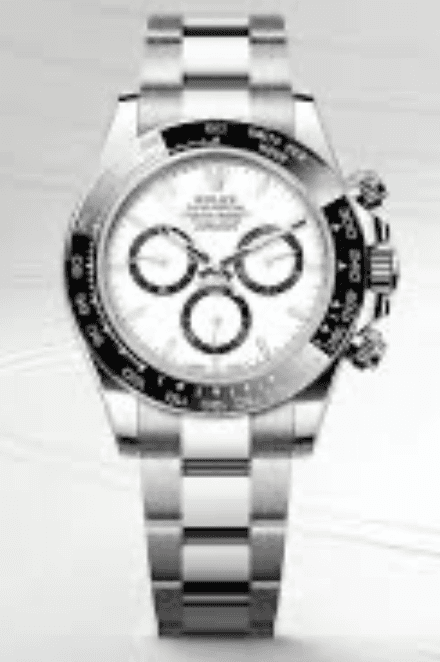
- ◆Automatic calibre 4131, 72h power reserve
- ◆Ceramic Cerachrom monobloc bezel with engraved tachymeter
- ◆40mm Oystersteel case, Oysterlock bracelet with Easylink extension
- ◆Retail £14,300; secondary £19k-£24k for white panda configuration
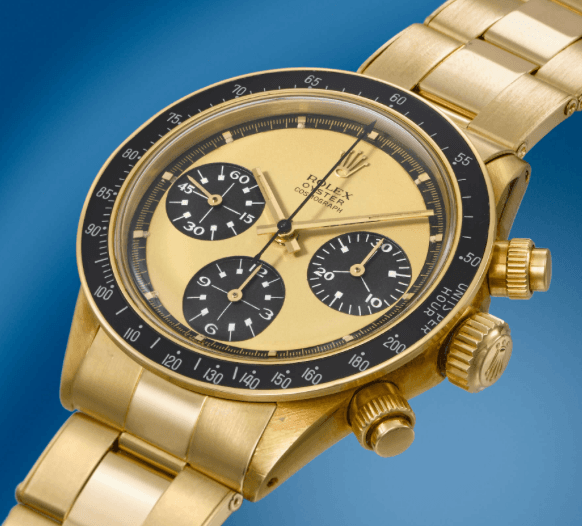
The Daytona has a single uninterrupted claim on motorsport horology since 1963. Its connection to actual racing is largely retrospective — the watch was a slow seller for most of its first two decades, and Rolex used to give them to Daytona racers because they wouldn't sell otherwise — but Paul Newman wore one, drove a 911 in it, and the rest is the most famous re-write in watchmaking marketing.
The 126500LN, launched at Watches & Wonders 2023, is the cleanest expression of the modern Daytona. The ceramic bezel is now part of the case rather than a separate component, the case-back is transparent for the first time on a steel Daytona, and the in-house calibre 4131 brings the reserve up to 72 hours and adds a regulator that Rolex calls the Chronergy escapement.
The white panda configuration is the single most consistently demanded modern Rolex of the last 18 months. Most dealers will tell you it's their single most requested watch, full stop. Our 126500LN moves within a fortnight, every time. The black-on-steel configuration trades at a 10–15% discount to white panda.
- ◆Hand-wound calibre 3861, 50h reserve, 4Hz
- ◆Aluminium tachymeter bezel with engraved scale
- ◆42mm stainless steel, choice of Hesalite or sapphire crystal
- ◆Retail £6,700–£8,200 depending on crystal/bracelet
- ◆Master Chronometer certified to METAS — the highest production-watch accuracy standard
The Speedmaster is the only watch ever flight-qualified by NASA for manned spaceflight. Buzz Aldrin's was strapped over his suit on the lunar surface in 1969 (Neil Armstrong left his in the Eagle as backup for the mission's onboard timer). Every Apollo mission flew with one. The current 3861 movement, introduced in 2021, is the first major movement update since 1968's calibre 861, and it brought the watch to METAS Master Chronometer certification — the most demanding accuracy and antimagnetic standard in production watchmaking.
It is also, mechanically, the more interesting watch of the two. Hand-wound, with a movement architecture that traces directly back to the calibre 321 of the 1950s, the Speedmaster is a pure horological exercise. The chronograph is column-wheel actuated; the lateral clutch is the original cam-based design that gives the watch its distinctive crisp pusher feel. If you only own one chronograph and you want to know exactly what's happening inside it, the Moonwatch is the answer.
The Hesalite-crystal version is the one to buy. The slight distortion of the acrylic crystal is part of the watch's character, the spare-strap inclusion is generous, and the price differential to the sapphire-crystal version (about £1,500) buys you an outsized accuracy and longevity advantage.
The verdict
Our take
If you buy with your wrist, the Daytona. The Daytona is a more comfortable watch, a more recognisable watch, and — depending on configuration — a better store of value. If you can find one at retail, you should buy it; you almost certainly cannot.
If you buy with your head, the Moonwatch. The Speedmaster is the more interesting horological object, the more honest tool watch, and the more accessible price point. It is the only watch that has been to the Moon, and that fact is going to matter more in 2050 than it does in 2026.
Most serious collectors end up with both — usually the Daytona first, when they want a watch that reads at a hundred metres, and then a Moonwatch six months later when they realise what they actually want when they're alone with a watch is something they understand all the way down.
The configuration question. Within each line, the configurations matter. White panda Daytona over black panda by 10–15% on the secondary. Hesalite Speedmaster over sapphire because the slight crystal distortion is the watch's signature and the Hesalite version comes with a spare strap and a loupe in the box. The bracelet Speedmaster over the strap version because the bracelet is the under-rated component of the modern Moonwatch — a notable improvement on the bracelets of the 1970s and 1980s.
The market position. The Daytona has appreciated against retail for fifteen straight years. The Speedmaster has tracked retail with mild seasonal variation. As an investment thesis the Daytona wins easily; as a watch you actually wear, the Speedmaster wins more often than its market position suggests.
On servicing and longevity. Both movements are serviceable indefinitely with proper maintenance. The Daytona's automatic calibre 4131 is more complex but Rolex's service network is the most accessible in luxury watchmaking; expect a major service every seven years at roughly £900. The Speedmaster's hand-wound 3861 is simpler, can be serviced by a competent independent watchmaker, and benefits from Omega's standardised parts catalogue going back to the 1968 calibre 861. Across a thirty-year horizon, both watches will cost roughly the same to maintain — the Speedmaster slightly less because of independent-service availability.
For the bigger market picture, our The Secondary Market in 2026: Where Prices Are Actually Going tracks both references quarter by quarter. For more on the modern Daytona, see Five Discontinued Rolex References Worth More Than Their Successors for context on the references that came before it.