Introduction
There are rare watches, and then there are watches that exist in a category almost entirely their own. The gold-cased Rolex Cosmograph Daytona reference 6263 fitted with an exotic "Paul Newman" dial belongs emphatically to the second group. This is not a watch that comes to market often. When it does, it commands the attention of the most serious collectors in the world, and the results at auction have been, in several instances, genuinely historic.
To understand why, you need to understand the confluence of factors that makes this particular configuration so singular: the reference itself (the final generation of the hand-wound Daytona, a reference produced for roughly seventeen years with screw-down pushers and an Oyster case); the case material (gold, produced in significantly smaller quantities than steel throughout the entire hand-wound Daytona lineage); the dial type (the exotic Art Deco Singer-made configuration that carries Paul Newman's name by association, produced only at the earliest stage of the 6263's production run and in extremely limited numbers); and the condition sensitivity that applies to all of these factors simultaneously when a watch has been in existence for more than fifty years.
Quick Specifications
- Brand: Rolex
- Model: Cosmograph Daytona (Oyster Cosmograph)
- Reference: 6263
- Case Material (focus of this article): 14k yellow gold or 18k yellow gold. The 6263 was produced in both fineness levels; 14k examples are understood to have been primarily, though not exclusively, destined for the US market. Sources conflict on precise market distribution and no hard rule applies — buyers should assess each example individually
- Case Size: 37mm diameter; approximately 13mm thickness including acrylic crystal
- Dial: Exotic / Paul Newman configuration — see Variations section in full detail
- Bezel: Fixed black acrylic insert with tachymetric scale, calibrated to 200 units/hour. The same acrylic bezel applies to the gold 6263 as to the steel version; the contrast between precious metal case and black acrylic is a defining visual tension of this reference
- Crystal: Acrylic / plexiglass, domed
- Bracelet / Strap: Period-correct examples were typically worn on a gold Oyster bracelet (matching case metal), riveted folded links on earlier production, or solid links on later examples. Some gold examples have been found over the years with leather straps, which was not uncommon for the era
- Lug Width: 19mm (noted across multiple specialist sources; some examples in dealer listings show 17mm — buyers should measure in person)
- Movement / Caliber: Valjoux Calibre 727, regulated and adjusted by Rolex; manual-wind
- Jewels: 17
- Frequency: 3Hz (21,600 vph)
- Power Reserve: Approximately 48 hours
- Complications: Chronograph — column wheel; running seconds at 9 o'clock; 30-minute counter at 3 o'clock; 12-hour counter at 6 o'clock; no date
- Water Resistance: Improved over earlier pump-pusher references by virtue of screw-down pushers and Oyster case construction; 50 metres is the figure cited across most specialist sources, though Rolex did not always formally publish this for vintage references
- Production Period: Approximately 1969 to the very early 1970s for gold exotic dial examples; the broader 6263 reference ran to approximately 1987
- Current Status: Discontinued; available exclusively through the specialist vintage secondary market
What Is the 6263 Gold Paul Newman?
The reference 6263 is the final generation of the hand-wound Cosmograph Daytona — the culmination of a development process that began with the reference 6239 in 1963 and progressed through six references before Rolex retired the entire manual-wind lineage in favour of the Zenith-powered automatic 16520 in 1988. The 6263 and its twin the 6265 (distinguished from the 6263 solely by their metal rather than acrylic bezel) were the last and most developed expressions of this era.
What defines a 6263 structurally is its Oyster case: screw-down crown, solid screwed caseback, and — critically — screw-down chronograph pushers. The gold Paul Newman 6263 adds two further layers of rarity to this already uncommon reference. First, gold production of the 6263 represents a small fraction of overall output — publicly available estimates derived from specialist sources suggest fewer than 2,400 gold examples were produced across the combined 6263 and 6265 references throughout their entire production runs. Second, exotic Paul Newman dials on the 6263 are known only from the earliest production, with serial numbers concentrated in the low two-million range. In gold, the combination narrows to a figure that specialist literature variously describes as a very small number indeed.
History of the Model
The Cosmograph Daytona was introduced in 1963 as a professional racing chronograph, priced at around USD 210. The "Daytona" name itself did not appear on the dial until around 1965 — early examples read only "Cosmograph."
The "exotic" dials now known as Paul Newman dials were produced by Singer, Rolex's dial manufacturer, to a design deliberately distinct from the standard Daytona dial — featuring Art Deco numerals on the subdials, a stepped construction, square-ended minute track markers, and contrasting-coloured recessed subdial areas.
The 6263 arrived approximately 1969 to 1971. Its exotic dial examples carry the earliest serial numbers within the reference. After the earliest production period, the 6263's dials shifted to the standard configurations that characterise the majority of the reference's long production run. Exotic dials are not found on later 6263 serial numbers.
Paul Newman became associated with these exotic dials after Italian collectors noticed him photographed wearing a Daytona with an exotic dial in the early 1980s. His reference 6239 with a Panda exotic dial sold at Phillips New York in 2017 for USD 17.75 million. His personal reference 6263 — a standard Big Red black dial — sold at Phillips in December 2020 for USD 5.48 million.
Design Details
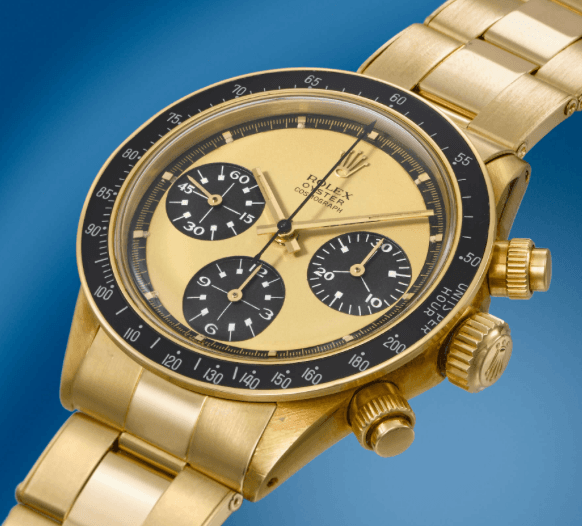
The gold 6263 presents a very different proposition from the steel version, despite sharing an identical case architecture. The yellow gold case — whether 14k or 18k — warms the watch entirely, and its contrast with the fixed black acrylic bezel is immediately more dramatic than steel against the same bezel.
The exotic dial in a gold 6263 context typically presents in either a black configuration (with contrasting champagne or light subdials) or — in the rarest documented instances — the vivid "Lemon" or "Limoncello" champagne-yellow ground with white subdial printing.
The stepped construction of the exotic dial — with the outer minute track area and the subdials both recessed relative to the main dial surface — is invisible in photographs and immediately apparent in person. Running a fingernail across the surface reveals the architecture of the dial in a way no image can communicate. This is the feature that separates an original Singer-made exotic dial from the convincing fakes and "non-step" variants that have circulated in the collector market for decades. The stepped plate is the primary physical authentication test.
Movement and Technical Details
The Valjoux Calibre 727 is a manually wound column-wheel chronograph adjusted and decorated by Rolex. It is the same movement that powers the steel 6263, and there is no movement specification difference between gold and steel examples of the reference.
At 17 jewels, the 727 is a resolved and durable movement — not complex by modern standards, but executed with the robustness that made Valjoux the preferred supplier for serious professional chronograph applications in the 1960s and 1970s. The column-wheel architecture provides consistent chronograph actuation. The power reserve of approximately 48 hours is modest by contemporary expectations but entirely adequate for daily wear with morning winding.
The movement is wound via the crown and cannot be wound while the chronograph is running on most examples. The acrylic crystal is an element that polarises opinion. It scratches more easily than sapphire and requires more careful daily wear. Many collectors prize it precisely for this: a well-aged acrylic crystal carries the marks of its history in a way that a virtually indestructible sapphire cannot.
Variations of the Gold 6263 Paul Newman
Champagne (or "Lemon") exotic dial — 18k gold case. The apex variant. The most celebrated example, known in the specialist literature as "The Legend," is one of only three examples known to exist globally of an 18k gold Oyster-case 6263 with a "Lemon" exotic dial. When it first appeared at a 2013 Christie's auction in Geneva, it set a world record for any Rolex Daytona sold at auction at the time, realising CHF 841,300. It returned to Christie's Geneva in November 2022 with an estimate of CHF 3,000,000 to 5,000,000.
Black exotic dial — gold case. Less documented than the Lemon configuration in terms of confirmed known examples, but present in the scholarship. The gold case against a black exotic dial produces a watch of extreme visual authority.
ROC vs Oyster Sotto dial text distinction. On the 6263, the exotic dial text falls into two categories based on the order of inscriptions beneath the Rolex coronet. Specialist literature, including documentation published by Sotheby's, suggests fewer than 25 total "Oyster Sotto" 6263 examples are known to exist across all case materials.
14k versus 18k gold. Both fineness levels were produced. Neither fineness commands a categorical premium over the other among the most knowledgeable collectors; condition, dial originality, and case sharpness are all more determinative of value.
Market and Price Context
The market for gold 6263 Paul Newman examples is thin, opaque, and results-driven. Verified public auction results span a significant range, driven by dial variant, condition, case sharpness, completeness of original components, provenance, and the specific dial designation. "The Legend" — the 18k gold Lemon dial example — carried a CHF 3,000,000 to 5,000,000 estimate at Christie's Geneva in 2022. A Panda Paul Newman 6263 sold by Sotheby's in December 2024 achieved USD 312,000.
Case sharpness is paramount — gold is soft, and decades of wear will round and soften the lug profiles. Dial originality is the single most value-determinative factor. Movement originality is assessed by expert movement specialists. No transaction at this level should proceed without independent authentication by a recognised Daytona specialist.
Buying Advice
Independent authentication is non-negotiable. The market for Paul Newman Daytona dials has attracted sophisticated forgeries for decades. Engage a recognised specialist before committing to any purchase.
Original components throughout. Assess the originality of every component: crown, pushers, bezel, crystal, bracelet or strap, caseback, hands.
Case condition. Examine the lugs under magnification. On an unpolished case, the lug edges should be sharp and the lug surfaces should show the flat satin geometry of the original finishing.
Provenance where available. Single-owner, fresh-to-market examples with documented ownership history command premiums that can be very significant.
Source through specialists. Transact through auction houses with specialist vintage Rolex departments, or through dealers who have handled documented examples of this specific configuration.
Final Thoughts
The gold Rolex Cosmograph Daytona 6263 with a Paul Newman exotic dial is one of the most fully realised examples of what vintage watch collecting, at its most serious, actually involves: a convergence of extreme rarity, verifiable history, genuine mechanical quality, and a cultural association powerful enough to have reshaped an entire market. Wind It Up Watches can help source a verified example through our trusted network.